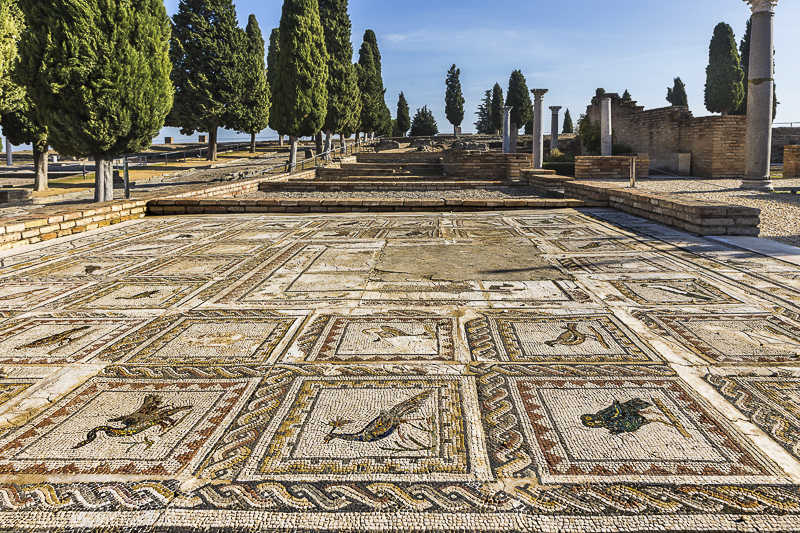
Italics Ruins are the remains of an ancient Roman city located in the present municipality of Santiponce (Sevilla).
It is a really impressive visit that you should not miss to know the history of the city that gave three emperors to the Roman Empire.
What are the ruins of Italica?
Ruins Italics are subject to visit and admiration by many Spanish and foreign travelers. Although it was not enough to save her from being the subject of continued dispossession and quarry materials since the Arab era, this city was of great importance.
It reached the Muslim era with the name “Talika / Taliqa”. It was not until it was abandoned in the twelfth century that Christians referred to it as “Sevilla la Vieja”. In 1740, the Seville City Council ordered the demolition of the walls of the amphitheater and the construction of a dam on the Guadalquivir.
Under the Napoleonic occupation, on February 9, 1810, the first legal standard of protection for the site was established, suggesting the restoration of the old name of Italica.
In addition to restoring the name, an annual budget for regular excavations was earmarked, although these did not materialize until 1839-1840. Italica in Seville was declared a National Monument by the Royal Order of December 13, 1912. Currently, the Roman Ruins in Sevilla are the main tourist attraction, located 7 km north of Sevilla.
What to see in the Ruins Italics?
A tour of Italica in Seville is a wonderful appreciation of Roman culture, allowing us to enjoy various tourist sites, beautiful nature, and rich culture.
It is definitely one of the best things to see in Seville. A visit to Italica serves as a central basis for various events, such as the international Cross Italica in January, the Stations of the Alcor Lent, or the Theatre and Dance festivals.
It is also a popular spot for families to enjoy meals on weekends, with typical establishments like the “Ventorrillo Canario Restaurant”.
Living Museum
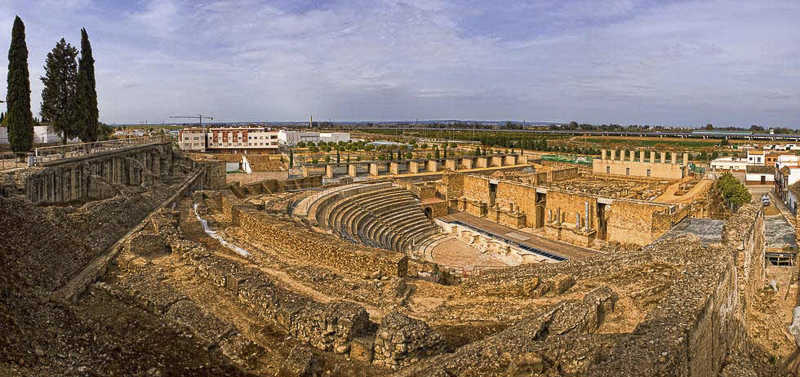
The theater is the oldest and best known of Italica, with the remains of the curia discovered in 1984. It is located in the Cerro de San Antonio, to the west of the community of Santiponce.
This theater was built between the 1st centuries B.C. and A.D., showing sporadic use until at least the fifth century. The approximate location of the building was known since the eighteenth century, where some of the sculptures of the Roman Ruins of Sevilla were found.
In the yard of one of the houses on the hill, part of the stands was discovered around 1940. The first excavations in the area were conducted in 1937 by Francisco Collantes Terán.
However, it was not until late 1970-1973 that significant excavations occurred to uncover this theater, followed by smaller campaigns to free the porch. After this, several digs were conducted; the initial direction was under Diego Ruiz Mata, followed by José María Luzon Nogué. Under the direction of Luzon and Ramón Corzo, work continued into 1975, revealing the remains of the building stage.
Following various phases of restoration, which began in the 1980s, the theater is currently used for the celebration of the Festival of Theater of Italica.
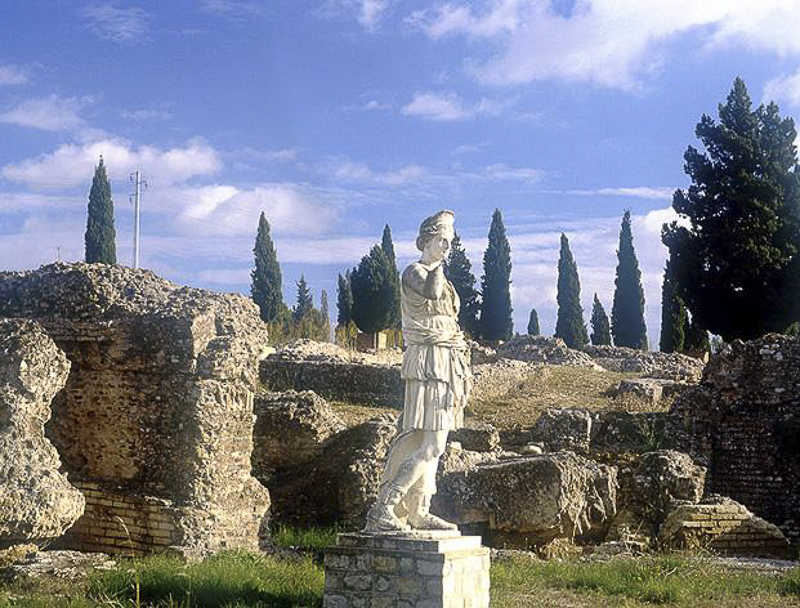
This recovery of the theater as a monument was directed by architects Alfonso Jimenez and Pedro Rodriguez, later joined by Francisco Montero. These measures were completed in 1995, with a reboot to finalize them by early 2012.
Near the entrance of the theater, there’s a museum room displaying some objects found during excavations. However, the most significant pieces are permanently housed in the Seville Archaeological Museum.
Roman Amphitheater of Italica in Seville
Italica’s amphitheater was built to the north of the first Hispanic-Roman city of Italica, currently located in the municipality of Santiponce (Sevilla, Spain).
This extraordinary monument was one of the largest amphitheaters in the empire, featuring three levels and a capacity of 25,000 spectators.
Traianeum
From its excavation between 1979-1980, it is assumed that “Traianeum” is a temple dedicated to Emperor Trajan, founded by his nephew, Emperor Hadrian.
Also known as the Temple of Trajan of Italica, it is located in the Plaza de la Nova Urbs, surrounded by an arcaded square with exedras.
Termas Older
The Older Termas consisted of two, one in the old city and another in the new city—both offering services such as public baths, saunas, and hot pools.
The new city’s baths are the largest, occupying an entire block of land; however, they remain largely unexcavated.
Mosaics
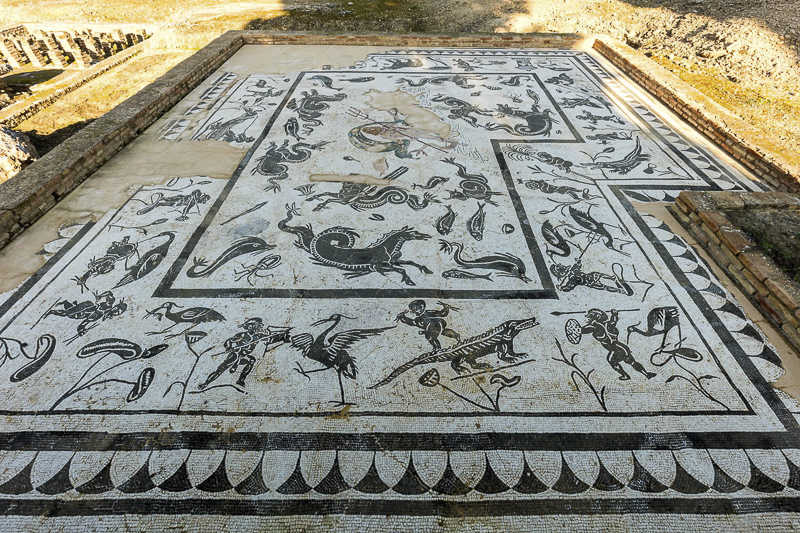
Among the most significant finds are relevant mosaics, including the mosaic of Neptune, located in a complex near the thermal baths. This polychrome figure of the god of the sea features a perfect procession of creatures in black and white, dating from the second century.
The mosaic of the labyrinth, found in the same building, is crafted with geometric figures representing a walled city with towers. Another important mosaic is the planetarium mosaic, created around the middle of the second century and located in the House of Planetarium.
One notable feature shows the seven planetary divinities, representing the names of the days of the week according to the Roman calendar. The Bird Mosaic features 33 different species of birds arranged around a now-lost emblem in a geometric framework.
Private Houses
The most spectacular aspect of this city is its homes or villas. Several stately homes have been built with magnificent mosaic decorations, many belonging to influential patrician families of the empire.
Notable ones include:
- Casa de la Exedra: Presiding over the central courtyard, featuring a beautiful fountain, hot spring, long arena, and other buildings.
- Neptune House: Contains hot springs, with several rooms beautifully decorated with mosaics, although it has not been fully excavated.
- Bird House: Houses rooms decorated with mosaics and recreates areas of the home from that time.
- House of the Planetarium: Contains a circle with seven medallions, each representing the seven planets named after the days of the week, with Venus (Friday) at the center, surrounded by the Moon (Monday), Mars (Tuesday), Mercury (Wednesday), Jupiter (Thursday), Saturn (Saturday), and the Sun (Sunday).
- Patio House Rodio: Partially excavated, located to the east, featuring a rhodium-type courtyard. This area often contained highly detailed mosaic pavements, which have deteriorated over time due to human activity.
- House Hylas: Another luxurious home in Italica, excavated partially. The yard is located to the north and is connected by a staircase to an anteroom, leading to a room with the “Hylas” mosaic, which gives its name to this beautiful home.
Useful information about the Monument of Italica
Visits to the ruins of Italica are authorized for all audiences. However, children under 14 must be accompanied at all times by a paying adult.
Prior entry cannot be obtained, and visits may be suspended due to atmospheric conditions; in such cases, the entrance fee will be refunded to the visitor.
Pricing for the ruins of Italica
Currently, the ticket prices for the ruins of Italica are:
- Children under 14 years: €5
- Adult members of the Club Gears: €7
- General adult entry: €8
Operating Hours
The archaeological site of Italica showcases a magnificent Roman amphitheater and offers a chance to stroll through the ancient streets and explore the homes.
The ruins of Italica can be visited from Tuesday to Saturday from 09:00 to 18:00. On Sundays and holidays, the hours are limited to 09:00 to 15:00. The site is closed on Mondays.
How to get to the Roman ruins of Seville?
A visit to Italica can be reached from Seville San Pablo Airport, located 12 km from the city center, which offers good flight deals.
You can access the Italics Ruins from San Justa station, which connects with various cities, as well as from the bus station in Seville. Additionally, a drive to Italica from Seville is possible.
There are no excuses for not visiting Italica!!