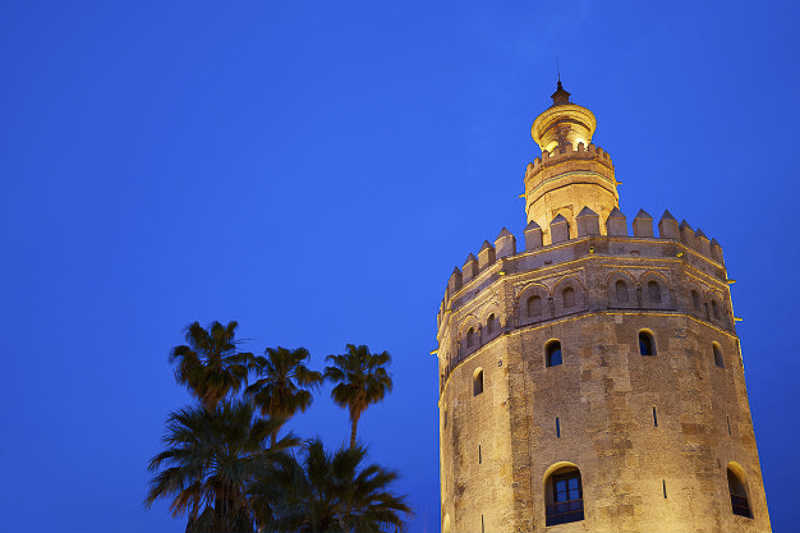
If you find yourself in Sevilla, you should visit Torre del Oro, or Tower of Gold in English, one of the most famous monuments and an impressive place. If you make a trip to Seville for a day or two, you are bound to see it.
This tower, wrapped between myths and legends, has a singular name that has become a memory of an Arab past, leaving an indelible mark on the city of Sevilla.
History of the Torre del Oro
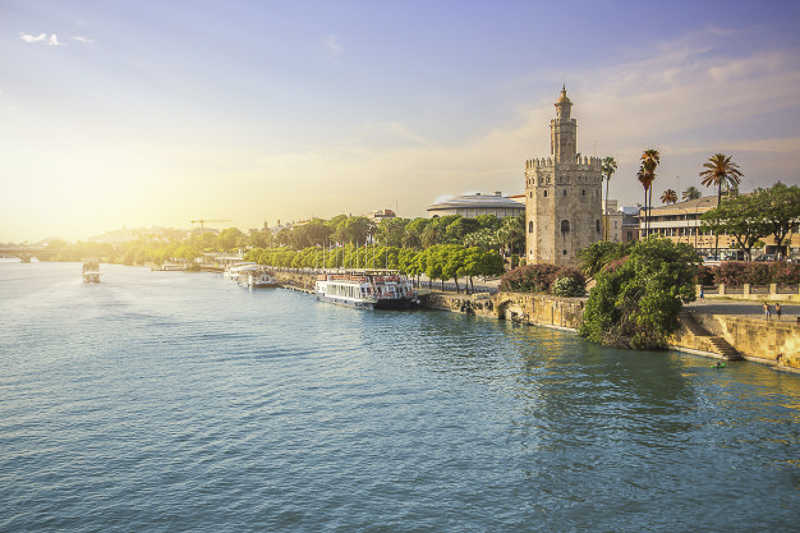
Sevilla showcases the striking mixture of Arab and Christian culture, inviting us to learn about its history through its monuments. Gold Tower was built between 1220 and 1221 when the Iberian Peninsula was under Islamic influence, specifically by the Almohad governor, Abu-Allah.
It served as a watchtower, fortified and separate from all the walls, communicating with Latorre Plate through a single wall. In 1931, Latorre Gold was declared a historic monument and part of Spain’s historical heritage.
After the conquest, the tower was given a religious use and became the chapel of San Isidoro de Sevilla. It also functioned as a prison, and legends emerged regarding its later uses by King Pedro I.
Adjacent to the tower was the port of Seville, through which goods traveled from various parts of Castilla and traded with the American continent.
In 1755, following the Lisbon earthquake, the tower was damaged, prompting the Marquis de Monte Real to propose its demolition to widen the road. However, thanks to protests from Seville, the King of Spain intervened and ordered restoration. The first restoration was carried out in 1990 by engineer Carlos Falcon, followed by several renovations until 2005.
What is your name? Rumors about the iconic name, Torre del Oro, have always emerged. One legend suggests that gold extracted from America was kept there, but this is not the true origin. Chronicler Luis Peraza states the name comes from the tower being covered in tiles that shimmered in sunlight.
However, history confirms that in the tenth century, during the events surrounding the conquest of Seville, it was already known as the Torre del Oro due to the bright radiance created by a mix of mortar, lime, and straw.
This brightness can still be seen from the roof of the Torre over the Guadalquivir River in Seville’s historic center. What was its purpose? The primary function of the Torre del Oro was to protect and defend the city from invading forces.
It was a crucial part of the Almohad wall surrounding the old city, completing the defensive system of the Islamic city. It was the main defensive point, safeguarding the port and controlling traffic in and out of the city.
Architecture, Building and Description of the Building
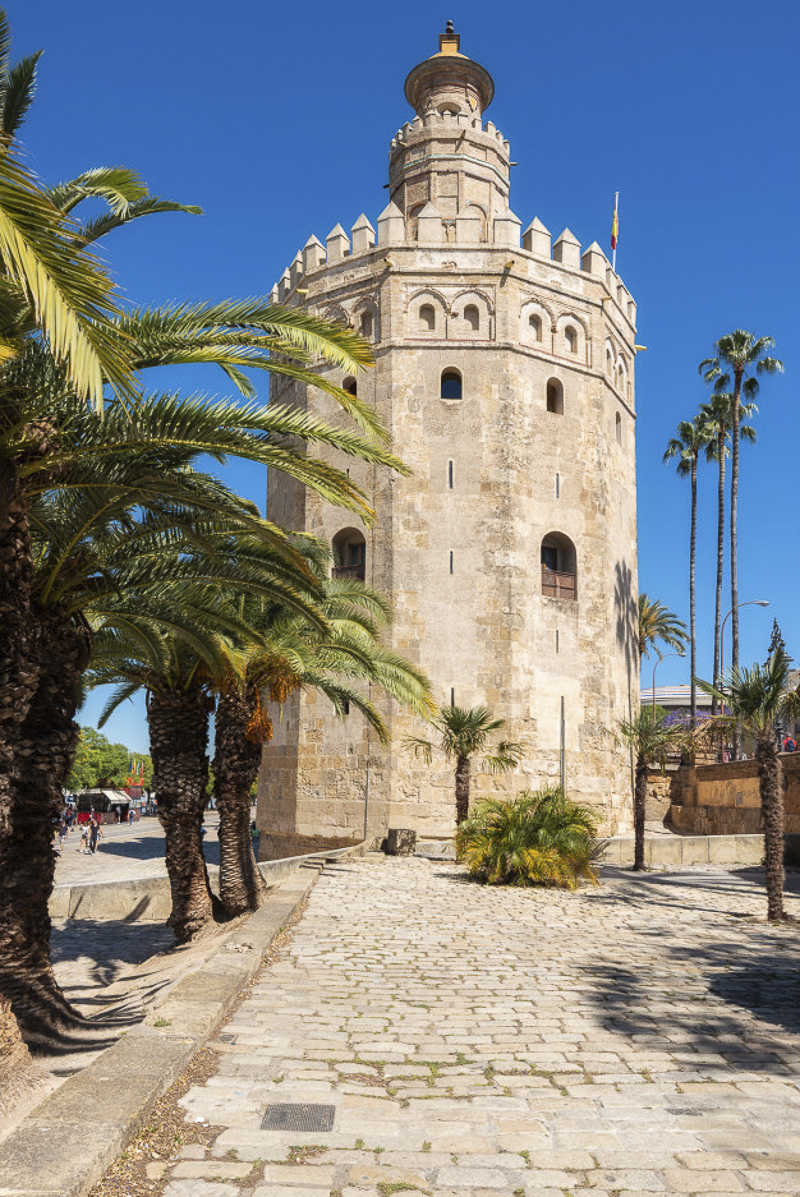
The Gold Tower stands at 36 meters high and 15 meters wide, constructed of stone blocks. It comprises three sections. The first is dodecagonal, built in 1220 by order of the Almohad governor. The second section was commissioned in the fourteenth century by King Pedro I, while the last was completed in 1760 after the earthquake.
Due to its proximity to the river, the foundation was laid on soft ground, requiring the addition of pine wood for stability. Currently, the Gold Tower has an 11-meter foundation, as 6 meters were added during restoration following the Lisbon earthquake.
Visit the Torre del Oro – Maritime Museum
The Gold Tower became the Maritime Museum in 1936 by order of the Ministry of Marine. Years later, restorations improved its façade, and two floors were established for displays.
By 1942, the tower had three floors dedicated to exhibitions. The first two floors showcased various works, while the third was reserved for researchers.
Four hundred pieces from the Naval Museum in Madrid were brought in for display, including historical elements of the tower and the harbor.
Ancient navigational instruments, figureheads, paintings, and nautical maps from the times of old sailors can be seen.
In the museum, different models of boats are displayed, such as the Real Fernando from 1817, the first steam ship built in Spain, and the “San Ignacio de Loyola,” a Spanish oil tanker that made 44 trips to Philadelphia before disappearing at sea in 1912.
Among the exhibits is a sixteenth-century Renaissance-style cannon and reproductions of the first world map made by a scientist of that era. Additionally, fossils and fishing tools from the exploration voyages of the time can also be found.
Useful Information on the Torre del Oro in Seville
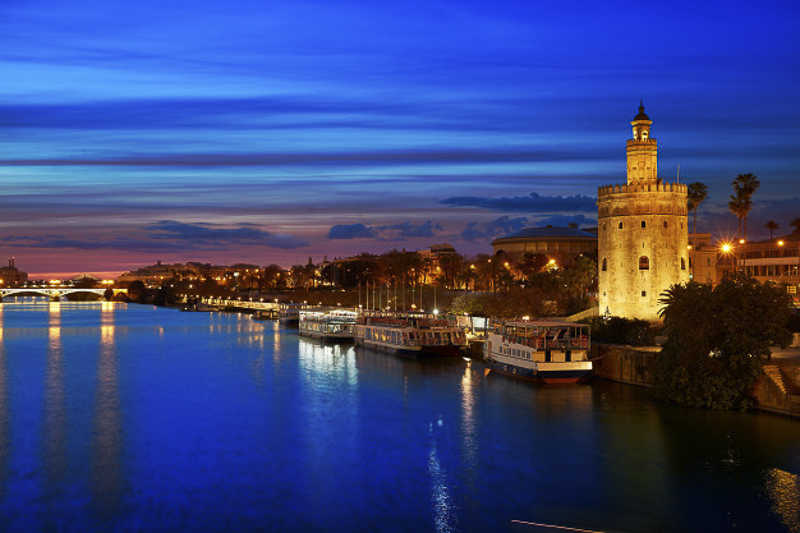
If you visit the Maritime Museum located in the tower, consider the time of year, as during high season, the capacity is 50 people per floor, and you may have to wait to enter. Eating inside the premises of the Torre del Oro is not allowed, and pets are prohibited.
Plans for demolition due to the neglect and abandonment of the tower were proposed, but the city’s inhabitants would not permit those plans to be carried out.
Sevilla, as one of the most visited cities by tourists, offers a variety of hotels and restaurants near the tower.
Ticket Prices for Torre del Oro
Ticket prices are economical and depend on the age of the visitors. Adults are required to pay the full ticket price of €3.00, while children ages 6 to 14, students, and seniors over 65 pay €1.50.
Additionally, individuals with disabilities and children under 6 have free access to the site. Mondays are free for the public.
Opening Hours of the Torre del Oro
From Monday to Friday, the operating hours of the Torre de Oro are from 09:30 to 18:45. On Saturdays and Sundays, it operates from 10:30 to 18:45, and it is closed on holidays. For more information regarding schedules and ticket prices, you can call 0034 954 222 419.
How to Get There?
You can enjoy a pleasant stroll along the riverbanks or use public transport to reach Torre del Oro. Seville boasts many points of interest, and the tourist bus can take you directly to the tower.
The double-decker bus allows for a great city tour, and you can hop on and off as many times as you wish once you have purchased a ticket. Buses depart every 30 minutes from each stop and the entire journey takes about an hour.
Alternatively, public transport can be used with lines 3, 21, 40, or 41, all of which reach the tower. In Seville, you can also find horse-drawn carriages known as “Calesas,” offering a unique and original way to explore the city.