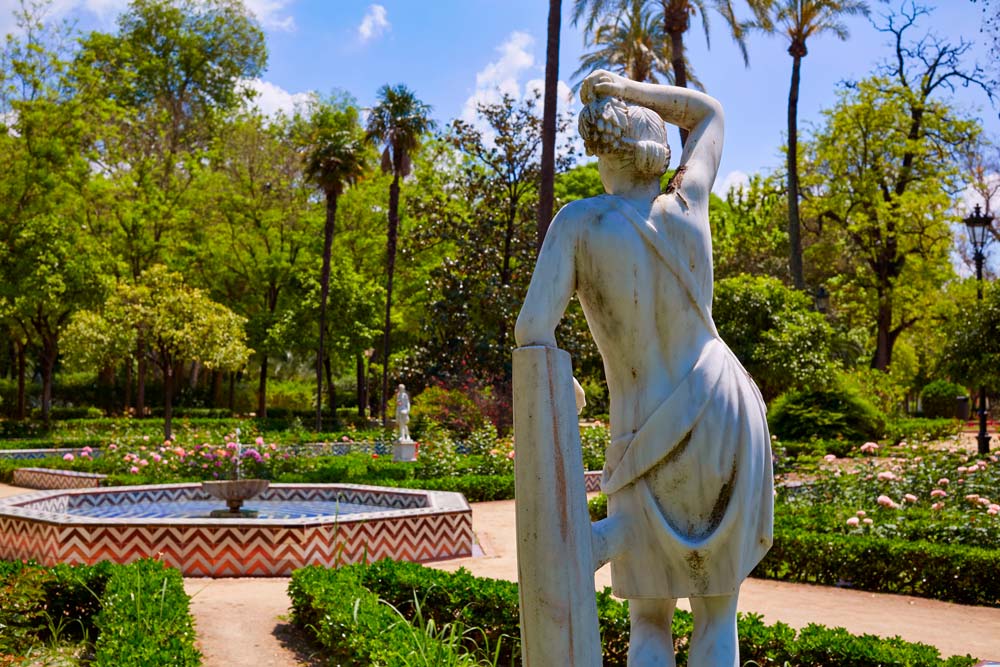
The María Luisa Park in Seville is without a doubt the most well-known in the city. In fact, it was declared a “Well of Cultural Interest” in 1983, specifically in the category of “Historic garden.”
With a surface area of 34 ha covered by a fresh green mantle, the Maria Luisa Park is the main green lung of Seville, one of the prettiest parks in Spain, and one of the best-loved spots in the city.
This park is a space that evokes a feeling of joy. It resembles a romantic garden, featuring extensive areas filled with relaxing aromas. The soothing sound of its fountains generates peace and incomparable relaxation.
In 1893, the infanta María Luisa Fernanda de Borbón, the widow of the Duke of Montpensier, decided to donate part of the private gardens of the Palace of San Telmo to Seville. As a result, it was opened as an urban park in 1914.
In 1929, the park saw the addition of the Squares of Spain and America for the Ibero-American Exhibition of that same year, becoming one of the park’s main monuments.
Wonders of the Parque de Maria Luisa of Seville
Movie
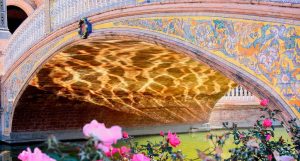
This magnificent square was built by Aníbal González in 1929. It is the main building and the largest structure from the Ibero-American Exhibition in the city that year.
This square is a popular photography spot due to its beauty. On several occasions, famous movies, such as “Star Wars,” have used it as a backdrop. It is also widely chosen for wedding photography and romantic promises.
The place symbolizes “a hug from Spain to its former territories” and is filled with romance, especially around its boating areas.
Movie
The Glorieta de Bécquer
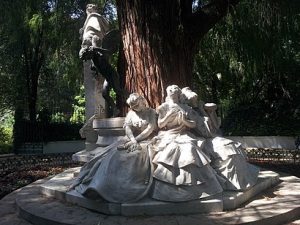
A monument to a poet and a love song. Its circular shape focuses on a monumental Taxodio—bald cypress—approximately one hundred and fifty years old. The term “calvo” refers to its light and majestic foliage that turns red and falls in autumn: a symbol of lost love. In spring, the elegant green foliage returns, representing the beginnings of love.
This monument was designed to encourage a circular perception, thus relating it to the idea of eternity. Within the circle, you can find a sculptural group embraced by the Taxodio. The poet, carved in marble, is elevated on a pedestal. At his feet is a bronze figure representing wounded love, while to his left stands Cupid, ready to shoot arrows.
On a bench are seated three female marble figures, each representing a stage of love:
- Love excited
- Love possessed
- Lost love
Glorieta de Bécquer
The Monte Gurugú in the Maria Luisa’s Park of Seville
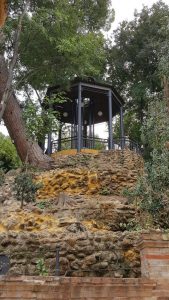
This area was built in 1929 as a tribute to the disaster of Annual. It serves as a replica of the “Monte Gurugu” located in the Sierra de Nador, Morocco, where visitors can enjoy beautiful views of Seville’s Maria Luisa Park.
This elevation features a stone staircase leading to a dome at its apex. It also includes a waterfall, creating an enchanting atmosphere thanks to the lush vegetation, humidity, and the soothing sounds of cascading water.
Monte Gurugu in the parque de Maria Luisa of Seville
The Islet of Birds
This pond, created in 1929 for the Ibero-American Exhibition, is home to various birds, including swans, peacocks, pigeons, and ducks, among others.
Surrounded by rustic stones, the pond features an island accessible via a small bridge. There is also a designated island for the birds.
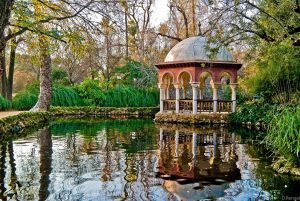
Island of the birds
The Gazebo of the Shell
Designed by Forestier, along with ceramist Manuel Garcia Montalván and sculptor Manuel Delgado Brackenbury, this gazebo is named for its copper-colored shell at the center.
It is adorned with hedges of burning bushes and Jupiter trees, native to Japan, among other flowering plants.
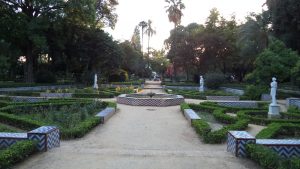
Glorieta de la Concha
The Pond of Lotus
This area features cypress swamps, wrapping vines, and various trees, inviting you to rest or read.
The pond is characterized by its rectangular shape, with a solitary marble fountain and a sculpture honoring Infanta María Luisa of Bourbon.
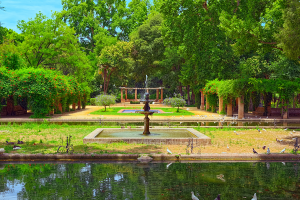
Pond of Lotuses
Plaza of America
This lush garden attracts numerous pigeons, captivating the public, along with its arbors filled with rose gardens and palm trees.
The garden includes an octagon featuring a radiant araucaria and is surrounded by four seating areas. A ledge was intended for libraries to store reproductions of figures from Don Quixote and Sancho Panza, which are currently missing.
This square is also home to three prominent buildings:
- Museum of Arts and Popular Customs
- Archaeological Museum
- Royal Pavilion
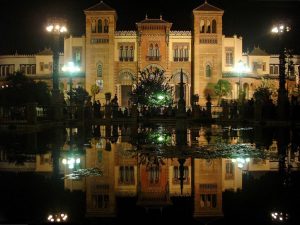
Plaza of America
Location of the Park
Seville’s Maria Luisa Park is located on the banks of the Guadalquivir River, near the Prado de San Sebastián, the youth hostel, and the Teatro Lope de Vega.
You can access it from the center of the city by exiting from Puerta Jerez via Calle San Fernando and Glorieta del Cid, or from the neighborhood of Santa Cruz by crossing the Gardens of Murillo, entering from the north next to the Casino de la Exposición and Plaza de España.
Alternatively, you can enter through Avenue de las Delicias and La Palmera, where you would access the southern area, directly leading to the beautiful Plaza of the Americas.
Hours
The park is open from 8 in the morning. In winter, it closes at 10 at night, while in summer, it remains open until midnight.
If you’re on a family trip and looking for a special and different day, this park is undoubtedly one of the must-visit spots where you can experience the exquisite essence of Seville.