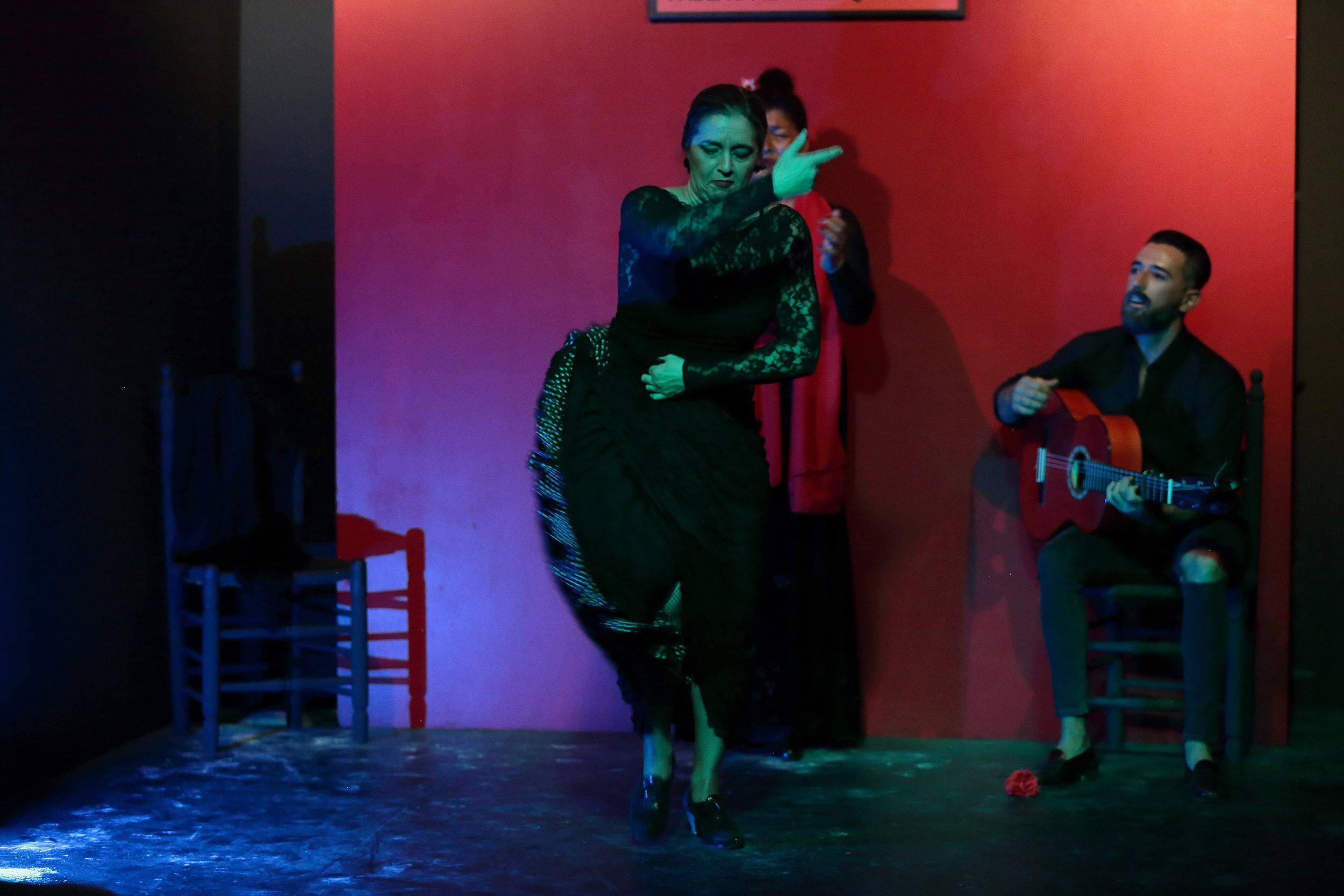
Seville is a different city, full of culture and history, where the bustle of its neighborhoods mingles with the friendliness and hospitality of its people. Flamenco in Seville is almost a religion; it is no wonder that the city of the Guadalquivir is considered the cradle of this universal art.
The spontaneous tapping, the “cante jondo,” and the wonderful plucking of the Spanish guitar can be felt in every corner of the city.
The capital of Andalusia is rich with treasures, but just having the chance to enjoy the art of a flamenco tablao in Seville—be it a soleá or a bulería—is already worth the visit. Nowhere in the world is flamenco as alive as it is here.
A flamenco tablao in Seville: an incomparable show
For decades, tablaos have occupied a privileged place in the history of flamenco.
They are venues where amateurs, professionals, and critics of this versatile and pure art come together. It is here that the great stars of dance, singing, and guitar shine.
In each tablao, a welcoming and familial atmosphere catches the visitor forever, even if it’s their first time experiencing flamenco.
History of the flamenco tablaos
The origins of the tablaos flamencos can be traced back to the singing cafés that flourished in Seville and elsewhere in Andalusia during the 19th century.
These cafés introduced flamenco to the general public, as before, these shows were limited to private celebrations and parties.
The singing cafés had layouts very similar to today’s tablaos flamencos: halls featuring a large tablao at the center, where artists performed, surrounded by chairs and tables for attendees.
The so-called Golden Age of Flamenco, which spanned from 1860 to 1919, was driven by the singing cafés. During this period, significant flamenco schools emerged in the Triana neighborhood of Seville and in the town of Jerez de la Frontera in Cadiz.
Between 1910 and 1955, some of the greatest flamenco singers in history emerged. It was during this time that the Spanish guitar became the primary instrumental accompaniment to what is known as cante jondo.
The development that took place in Spain at the end of the 1950s and the beginning of the 1960s attracted millions of tourists. All of them fell in love with flamenco, an art form that was largely unknown outside our borders. Soon, it was considered a pure musical genre, akin to jazz and blues, gaining followers across all five continents.
It was during the 60s that the concept of the old singing cafés evolved into what we now know as tablaos flamencos.
Today, flamenco in Seville, and in any place with a good flamenco tablao, stands as one of the great tourist attractions, drawing both Spaniards and foreigners. It offers an unbeatable way to enjoy culture and tradition.