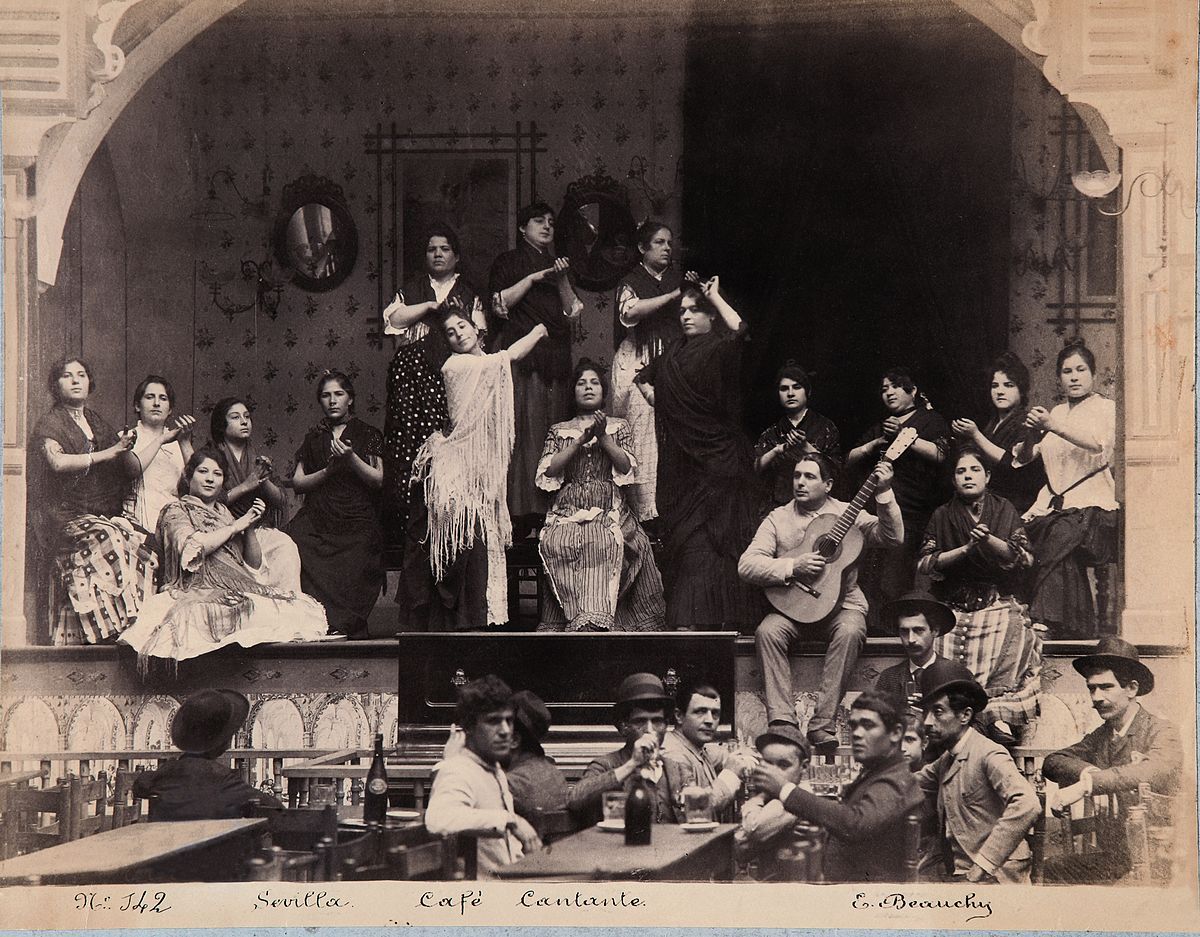
At the beginning of the 20th century, flamenco in Andalusia, and practically all of Spain, enjoyed a period of special splendour. This was due to the right conditions created by a public fond of our art and a series of figures in singing, guitar, and dance of the highest quality in a flamenco that had become professional. Establishments that played a fundamental role in promoting and disseminating our culture were the singing cafés.
The singing cafés emerged in the mid-nineteenth century as private venues open to the public for leisure and entertainment. These cafés hosted singing, guitar playing, and flamenco dancing shows. Although other musical styles coexisted in these spaces, flamenco quickly became the main attraction, marking its way into new public venues.
From 1846 onwards, these establishments proliferated in the main Andalusian cities and in Madrid. Here, up to 50 cafés operated at the same time, featuring the best Andalusian artists. However, it was undoubtedly the Sevillian singing cafés that marked the course and destiny of these venues.
They also extended to rural areas, though with less refinement and a clear predominance of local cantes and cantaores. This new way of showcasing flamenco culture ultimately spread throughout Spain via the cafés, where the best of the flamenco genre performed.
We can say that a large part of the history of flamenco is written in these cafés. They played a very important role, positively impacting our art. After a time when exhibitions were quite restricted and looked down upon by high society, flamenco began to spark great cultural interest among the general public. It moved beyond being known by a minority locked in bars, taverns, or private parties, reaching all social classes, even those outside Andalusia.
In addition to hosting the most important figures in the history of flamenco, they attracted intellectuals of the time. Writers and thinkers came regularly to enjoy the arte jondo, which in turn gained greater exposure and attracted new followers.
The cafés were indispensable for the professionalization of the flamenco sector. Through improvement and competition among singers, a great evolution occurred in artistic expression across each performance, with many styles and flamenco palos becoming well defined and perfected.
The interaction among artists from different regions led to the exchange of repertoires and styles, breaking away from strict locality. Competition could become fierce; for instance, Tomás el Nitri (Tomás Francisco Lázaro de la Santa Trinidad, 1838-1877) once refused to sing in front of Silverio (Silverio Franconetti Aguilar, 1823-1889) to avoid embarrassment. Nevertheless, Tomás received recognition for his mastery, with many friends appreciating his pivotal role at performances.
An increasing number of artists, both gypsies and non-gypsies from all over Andalusia, sought to participate, bringing about significant professional activity in the sector. This led to a substantial rise in the value of their work, leaving us an invaluable repertoire that was transmitted not only through family lineage and mentorship but also in the form of recordings preserved since the 1890s. These recordings serve as a central source for all current flamenco, demonstrating the greatness and significance of the singing cafés era.
In the realm of café flamenco, other accompanying instruments such as tambourines, violins, and bandurrias were completely eliminated. The voice and guitar emerged as the primary forms of expression in flamenco.
Initially, the main attraction was the dance, with singing serving as filler between performances, usually featuring the best singers. Gradually, singing gained greater importance, generating as much or more interest. By around 1870, singing became an activity meant to be listened to, with a public eager for it, while dances evolved to favor flamenco over boleros and folklore.
Around these circumstances, a golden era of flamenco unfolded, bringing forth many of the great figures in its history. Notable artists include Tomás el Nitri, Silverio Franconetti, Don Antonio Chacón (Antonio Chacón García, 1869-1929), Curro Durse (Francisco de Paula Fernández Bohiga, 1825), Enrique El Mellizo (Francisco Antonio Enrique Jiménez Fernández, 1848-1906), Manuel Torre (Manuel Soto Loreto, 1878-1933), Juan Breva (Antonio Ortega Escalona, 1844-1918), Fosforito el Viejo (Francisco Lema, 1869-1940), El Mochuelo (Antonio Pozo Millán, 1868-1937), el Niño de Cabra (Cayetano Muriel Reyes, 1870-1947), Ramón Montoya (Ramón Montoya Salazar, 1879-1949), El Canario (Juan de la Cruz Reyes Osuna, 1857-1885), La Malena (Magdalena Seda Loreto, 1877-1956), and La Macarrona (Juana Vargas, 1860-1947).
As for the decoration of these premises, they typically followed a common pattern. Generally, they can be compared to today’s flamenco peñas, sharing large halls with tables and a bar. The walls were often adorned with paintings and motifs related to flamenco and sometimes bullfighting, while a tablao served as the performance space. Illuminated by candles, oil lamps, or gas lamps in later years, some of these venues still retain their original architectural features, although most no longer exist.
A Start for the Singing Cafés in Seville
The first recorded reference comes from the cantaor Fernando de Triana (1867-1940) in his memoirs. He discusses the opening of Los Lombardos, located on the street of the same name (now Castelar), in 1947. However, this account was written 90 years later, and since he wasn’t born at that time, it can’t be definitively said whether that location was a singing café or simply a tavern where flamencos gathered.
Charming Places
If we take a route through Seville to visit the sites where they were established, we can still find some of these buildings standing—though, logically, many have changing uses.
During this period, numerous singing cafés were established in Seville. Some became famous beyond our borders for the quality of their shows and the artists who performed. The most important of all, nearly as significant as all the others combined, was the Café de Silverio—a true university of singing, playing, and dancing.
Making a brief overview of the locations of the singing cafés, here are some of the most remarkable:
Café de Lombardos
The oldest, according to Fernando el de Triana, was located on Lombardos Street (now Muñoz Olivé). One of its principal figures was the dancer Juana la Macarrona.
Café Teatro Suizo
This café was located on Sierpes Street at numbers 27 and 29, with exits on Cuna and Limones Streets, from 1860 to 1899. The iconic building later transformed into the well-known Teatro Imperial. Artists such as the master Pericet and Las Coquineras stood out here, and it was the first venue in Seville to offer a film session.
Café de Los Cagajones
Found in the Plaza de la Paja (now Plaza Ponce de León) in the 1860s, it featured debuts by figures like José Patiño and Antonio el Sevillano.
Café de Las Triperas
Located on Triperas Street (currently Velázquez), this café served as a stage for many great artists, including José Otero and Pastora Imperio, the latter honored today with a bust.
Salón Oriente / Salón Barrera
Owned by dancer Manuel de la Barrera and his children until its closure in 1884, this venue opened in 1865 on Trajano Street. José Luis Ortiz Nuevo notes that it was here the word “flamenco” was first used in an advertisement dated 21/04/1866, stating “Great concert of dances of the country with flamenco songs and dances”.
Café del Burrero / Café de la Escalerilla / Salón Recreo
Located at number 1 Tarifa Street, at the corner with Amor de Dios Street, it operated from 1865 to 1880. Initially, Luis Botella ran the Salón Recreo, also called Café Botella for some time. After his departure, Silverio Franconetti and El Burrero (Manuel Ojeda) partnered to establish Café de la Escalerilla, later becoming Café del Burrero—one of Spain’s most renowned cafés.
In 1881, it closed its doors, with Silverio and El Burrero separating to pursue their own paths, leading to the legend of Sevillian flamenco. El Burrero moved to number 11 Sierpes Street until Manuel Ojeda’s death resulted in the café’s definitive closure in the early 20th century. Many important figures performed there, including Fosforito el Viejo, El Canario, La Carbonera, and Silverio himself.
Café de Silverio
After Silverio Franconetti split from El Burrero in 1881, he opened his own café cantante, which found great success. Located at number 4 Rosario Street (between Tetuan and Méndez Núñez), it achieved unparalleled fame due to the excellence of its artists. Notably, Don Antonio Chacón, known as “El Papa del cante,” joined Silverio in 1886, along with other celebrated artists like La Serneta, La Macaca, Pepa de Oro, Antonia La Gamba, La Rubia, El Perote, La Macarrona, and La Malena.
During this period, a fierce rivalry developed between Chacón and Fosforito for supremacy in cante, leading Silverio and El Burrero to coordinate performances so fans could attend both cafés in one night.
Silverio eventually relocated to La Campana and opened Café Novedades, featuring artists like Juan Breva, la Niña de los Peines, and El Mochuelo, until permanently closing in 1889—the year of Silverio’s death.
Salón Novedades
Founded by Fernando González de la Serna y Pino in 1897, this venue aimed to revive the artistic ambiance of the old cafés like El Burrero and Silverio. Located at number 7 Santa María de Gracia street (corner with Martín Villa), the 18th-century building was demolished in 1923, as crowds carried banners reading “Novedades, nunca te olvidaremos” (News, we will never forget you). This venue hosted artists such as Niño Medina, Manuel Torre, La Coquinera, and Niña de los Peines, providing a platform for emerging talents like Pepe Marchena and Pepe Pinto.
Café del Arenal
Situated on La Mar Street (now García de Vinuesa), it operated from 1854 to 1892.
Café de La Marina
Probably located in the same premises as the previous café, it was active in the late 19th and early 20th centuries.
Café-Concierto Vista Alegre
This venue was active for only a few months in 1899 in the former Genoa Street (currently Avenida de la Constitución).
El Kursaal
Likely one of the last to close, it was located on O’Donnell Street, San Acacio (currently Pedro Caravaca), and was in operation from 1914 to 1935.
Salón de Variedades
Near the Alameda de Hércules, it had entrances at 23 Amor de Dios and 14 Trajano streets, functioning between 1918 and 1936.
Café de Variedades
Operating from 1866 to 1875, it was located at 13 Bayona Street (currently Federico Sánchez Bedoya).
Ideal Concert
In the Alameda de Hércules, it occupied number 24 Calatrava Street from 1919 to 1924.
Salón Olimpia
Located at number 1 Tarifa Street, it functioned until 1935, at the same site where the first Café del Burrero was established.
El Tronío
At 35 Sierpes Street, it closed in 1927.
Café Filarmónico
Situated in the Alameda de Hércules, like several others, it was located at Amor de Dios, Nº23.
Café Sin Techo
This served as a second venue opened by El Burrero during the summer, positioned at the corner of Reyes Católicos and Paseo de Colón. It was also known as “Nevería El China” and “Nevería del Burrero”.
Curiosities
-
Manuel Chaves Nogales, the famous writer and journalist, refers to a singing café called Cabeza del Turco, founded in 1922 on Sierpes Street. No additional information is available on the artists there or the flamenco styles that became the foundation for many modern songs.
-
La Nevería del China or del Burrero (El Café Sin Techo), located next to the Triana bridge, witnessed the death of El Canario by La Rubia’s father, contributing to flamenco’s bad reputation among high society on August 13, 1885.
-
After closing in 1936, El salón de Variedades was utilized as a provisional prison.
-
According to Fernando el de Triana, the tablao at the Café del Burrero was so expansive that bullfights occasionally took place there. It also provided boxes and rooms for wealthy families.
In 1908, a ministerial order arose from the negative reputation spread by genre detractors, questioning the usefulness of these venues. Since publications regarding events outnumbered those for shows, most cafés would disappear in the 1920s. However, they left behind a more complete, professionalized, and revalued flamenco, which reentered theaters, birthing a period known as the “flamenco opera.” This era saw artists such as Manuel Vallejo, Tomás Pavón, Pastora Pavón, Manuel Escacena, Pepe Marchena, Manolo Caracol, el Niño Gloria, Manuel Centeno, Manuel Torre, and Juanito Mojama take the artistic reins.
Fan interest and public presence only grew, fueled by the ever-expanding flamenco discography, which surged with the emergence of slate records.