Tetuán street of Seville is located in the downtown part of the city, bounded by the Plaza Nueva and Velázquez street while running parallel to Sierpes street.
An important shopping street of Seville, it ranks among the 10 most expensive streets in Spain. With a huge movement of people throughout the year, you’ll find numerous shops of leading brands, souvenir and gift stores, cafes, bars, and restaurants.
If you want to learn more about this prestigious commercial area of Seville, check out the following tips.
Learn about the history of Tetuan street in Seville
In the 15th century, this road was named “Monteros” because it was home to the huntsmen of King Fernando III. By the 16th century, the name changed to “Colcheros”, as many sellers and manufacturers of quilts lived there.
It wasn’t until the 19th century, specifically in 1869, that the street was christened “Tetouan” to honor the African city captured by General O’Donnell that same year.
Between 1931 and 1936, the republican authorities named it “Conquest of Tetuan.” However, once the Civil War began and the city was occupied by General Franco’s troops, the name was officially changed to “Tetuan.”
The pedestrianisation of calle Tetuán occurred in December 1991 in anticipation of the historic Expo 92, despite strong opposition from street merchants. This marked the beginning of the gradual pedestrianisation of the city centre.
Visit its most emblematic buildings
Most of the buildings on calle Tetuán date back to the first half of the 20th century.
Notable structures include the House of Ocaña Carrascosa at number 1, designed by Juan Talavera and Heredia, and the building at number 2, constructed by Aníbal González in 1917. At number 25, on the corner of calle Jovellanos, stands another work by Talavera and Heredia, commissioned by Francisco Gil Fernández in 1911.
For more than a century, calle Tetuán was home to the city’s most important theatre, the Teatro San Fernando, a main cultural center from its opening in 1847 until its demolition in 1973.
Know the history of the tile Studebaker of Seville
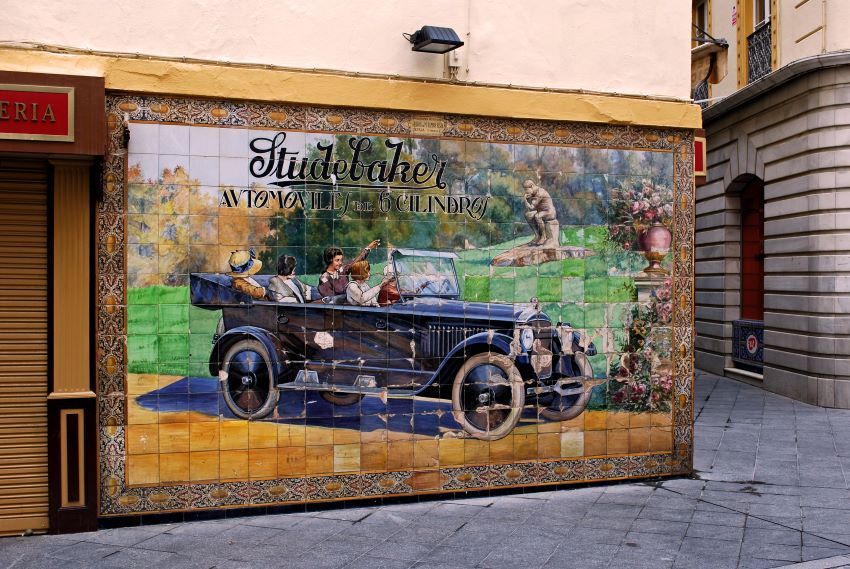
The Studebaker tile is one of the city’s most significant pieces of art. Developed in 1924 by the Factory Widow and Children of Manuel Ramos Rejano, it was created by Enrique Orce Marmol.
The tile depicts a countryside scene featuring a group of people gathered in a Studebaker car with Rodin’s The Thinker in the background. The tile reads: “Studebaker cars 6 cylinders.”
This tile has undergone numerous restorations and, due to its quality and location, stands as one of the best examples of early 20th-century advertising. This is a spot on calle Tetuán you can’t miss for a visit and a photograph.
Go shopping in the calle Tetuan in Seville
Like its parallel counterpart, calle Sierpes, the calle Tetuán is a favorite for shopping enthusiasts. It ranks among the top 10 commercial streets with the highest foot traffic in Europe, comparable to Gran Vía or the legendary Carnaby Street in London.
Some of the most visited stores on calle Tetuán include the clothing retailers C&A and Pampling, as well as the beauty product store Yves Rocher.
Eating in the calle Tetuan
The area around calle Tetuan is one of the best in Seville for tapas or a sit-down meal, particularly with the nearby lively streets of Sierpes, Albareda, and Alvarez Quintero.
Highly recommended in calle Tetuan is the Restaurant Il Vesuvio, popular among lovers of Italian cuisine in Seville. It boasts a great outdoor terrace perfect for enjoying both their magnificent pizzas and pastas, alongside the vibrant atmosphere of the street.
For something more traditional, don’t miss a visit to Bar Blanco Cerrillo, famous for its tasty tapas, especially the marinated anchovies, which are as well-known in the city as the Giralda.
Calle Tetuán in Seville offers an entire day of fun, especially if you aspire to emulate Julia Roberts in Pretty Woman and want to head home or to your hotel with your hands full of shopping bags and delight your palate with its excellent dining options.